The Evolution of the Floor: Why Comparing the NBA of 1996 to Today Is a Class of Systems, Not Skill
Every generation of basketball fans falls into the same cognitive trap: measuring past eras through the lens of modern aesthetics, or dismissing current basketball as soft because the baseline mechanics look different. To debate the NBA of 1996 against the modern product requires stripping away nostalgic hyperbole and examining how structural policy, spatial geometry, and data-driven shot selection altered the game.
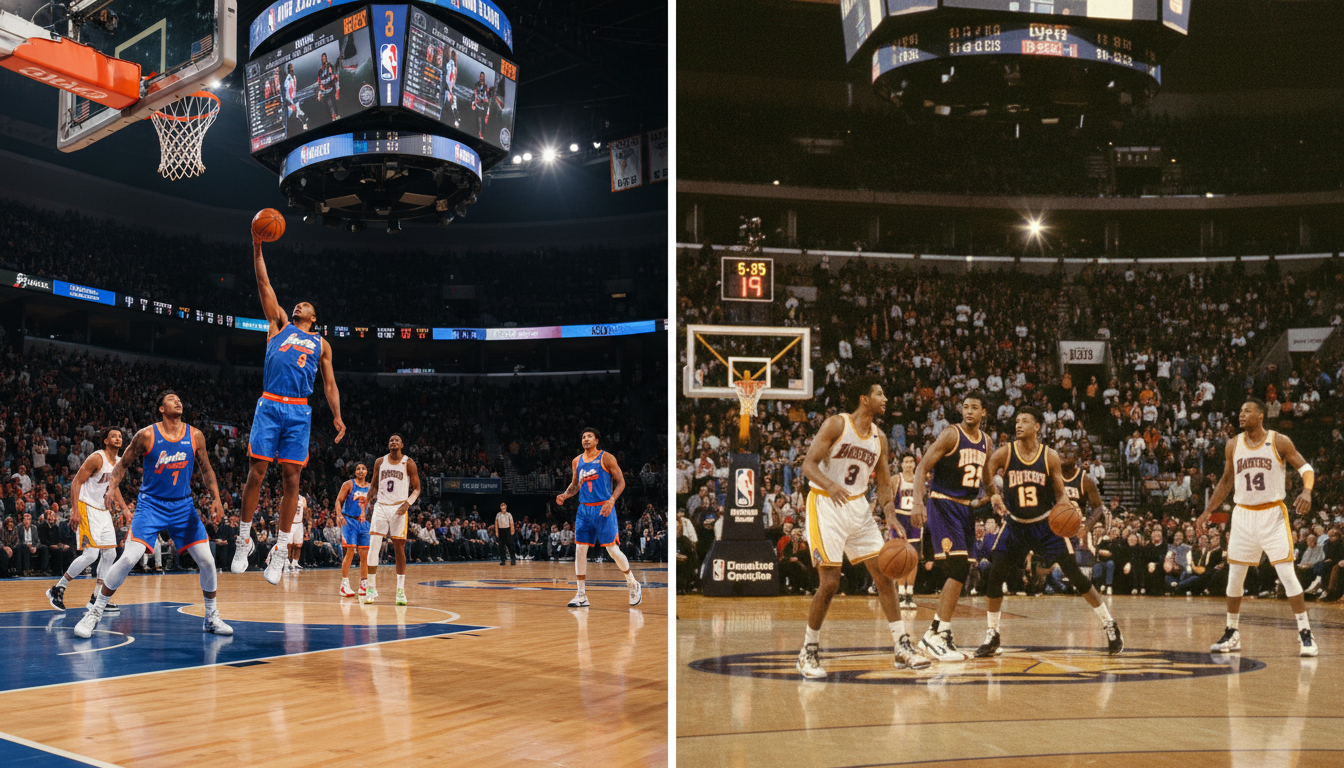
The argument is not whether today’s athletes are inherently "better" than their counterparts thirty years ago. The true debate centers on how officiating rules forced an evolution from a contact-heavy, isolation-driven game in the paint into a high-octane game played across 2,800 square feet.
The Mid-90s Archetype: Physicality, Isolation, and Rigid Roles
Thirty years ago, the NBA operated under a strict legal frame dictated by the "illegal defense" rulebook. Defenders were required to either double-team the ball handler explicitly or stay tethered to their assigned assignment. Soft zone coverage, shading into passing lanes, and building "walls" in transition were largely illegal.
This structural constraint shaped the strategic landscape:
Isolation as Primary Strategy: If a team possessed a dominant scorer—such as Michael Jordan, Hakeem Olajuwon, or Charles Barkley—they clear out four players to the far side of the floor. Defenders could not float off weak-side non-shooters to help without committing an illegal defense violation.
Hand-Checking and Freedom of Movement: On the perimeter, defenders could physically direct ball handlers using forearms and hands. Driving lanes were tight, contact at the rim was rarely penalized, and games frequently devolved into low-scoring defensive grinds.
Static Positional Roles: Traditional lineups featured two interior big men whose main responsibilities were rim protection, offensive rebounding, and scoring within 12 feet of the basket. Outside of specialists, long-range shooting was an auxiliary weapon rather than a core requirement.
The Modern Game: Spatial Geometry and Analytical Efficiency
Today’s NBA is the product of two major shifts: the deregulation of defense in the early 2000s (permitting zone and help concepts) and the total enforcement of "freedom of movement" rules. When defenders were permitted to load the paint and soft-double off non-shooters, offensive coordinators were forced to adapt.
The solution was spatial maximization:
The Math of Shot Selection: Advanced analytics proved that long 2-pointers (the dominant shot of the 1990s) were mathematically inefficient. Teams shifted their shot profiles to prioritize layups, free throws, and above-the-break 3-pointers.
Positionless Skill Sets: Modern centers are expected to handle the ball in transition, make decisions out of the short roll, and pull opposing rim protectors out to the perimeter. A player who cannot shoot or pass is an offensive liability that modern defenses exploit.
Pace and High-Volume Offense: The modern game runs at a significantly faster pace, with shot clocks resetting to 14 seconds on offensive rebounds to encourage continuous action.
The Verdict: Two Different Games Under the Same Name
Critiquing today's league for lacking defensive physicality misses the point: the NBA intentionally altered officiating guidelines to remove the brutal interior contact that slowed game flow during the late 90s. Conversely, arguing that 1990s players lacked skill ignores the fact that they operated within a rigid rule set that favored post-ups, mid-range battles, and heavy body contact over perimeter spacing.
The modern NBA demands higher baseline skills across all five positions on the floor. The 1990s NBA demanded higher physical tolerance, tactical resilience, and one-on-one mastery inside the arc. Rather than debating which era is objectively superior, the truer takeaway is that basketball evolved from a game of physical attrition into a game of geometric leverage.