
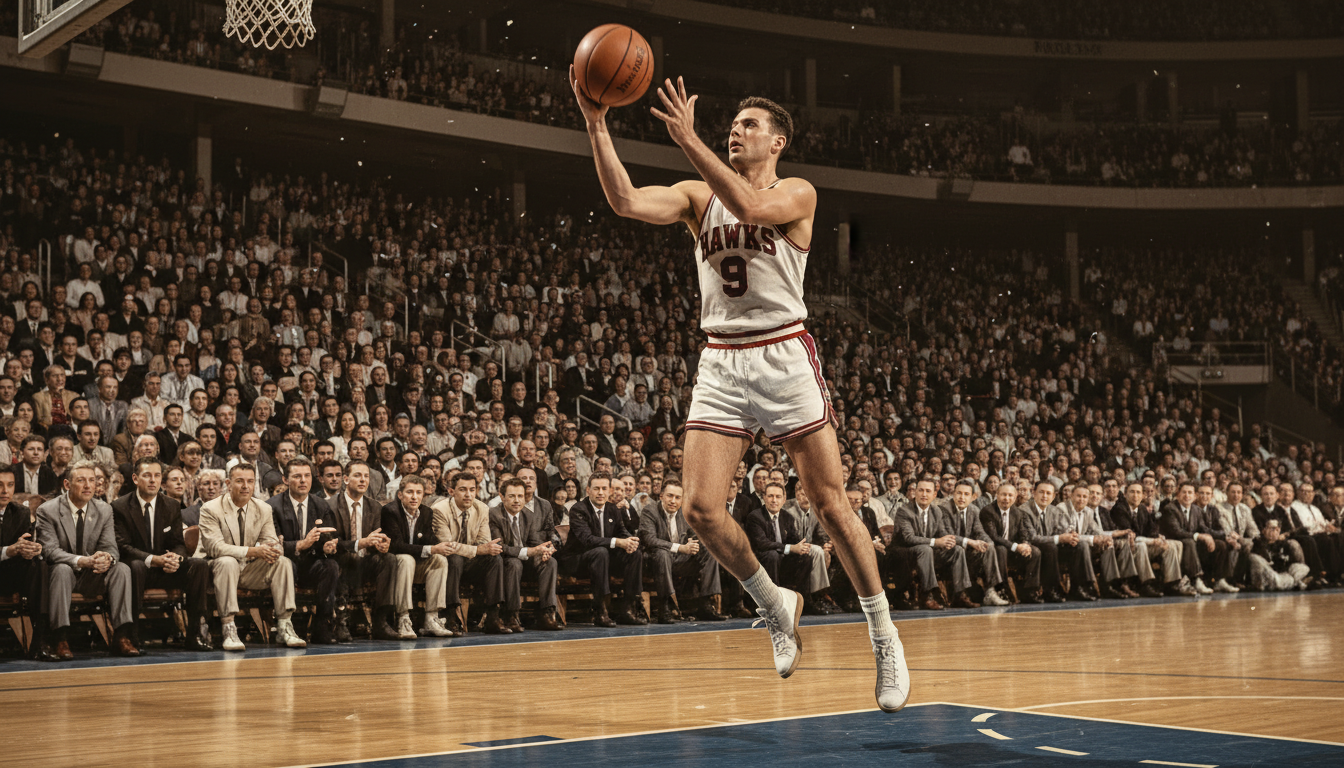
Bob Pettit 1958 NBA All-Star Game. Public Domain ©️ Bob Pettit Most Valuable Player in the 1958 NBA All-Star Game.
BOB PETTIT: REMEMBERING ONE OF BASKETBALL’S ORIGINAL GIANTS
The NBA’s first MVP, a champion and one of the game’s pioneering power forwards leaves behind a legacy that helped shape professional basketball.
TSports Magazine | Basketball • Legends • NBA
Long before the NBA became a global entertainment powerhouse, before billion-dollar television contracts and sold-out arenas became part of the league's identity, Bob Pettit was helping define what greatness looked like in professional basketball.
Pettit, the Hall of Fame forward who became the first Most Valuable Player in NBA history, died September 23 at his home in Metairie, Louisiana. He was 93.
His career belonged to another era, but his accomplishments remain remarkable by any standard.
Across 11 NBA seasons, all spent with the Hawks franchise, Pettit averaged 26.4 points and 16.2 rebounds per game. He was selected as an All-Star in every season he played and retired with 20,880 career points and 12,849 rebounds.
But statistics tell only part of his story.
THE NBA'S FIRST MVP
When the NBA introduced its Most Valuable Player award for the 1955-56 season, Pettit became its first recipient.
He averaged 25.7 points that season and would capture the award again in 1959, when he led the league in scoring at 29.2 points per game. He was also a four-time NBA All-Star Game MVP.
Pettit's style was particularly significant.
At 6-foot-9, he possessed the size to battle around the basket but wasn't confined to playing there. He could face the basket, score away from the rim and rebound relentlessly—a combination that helped establish the blueprint for what would eventually become the modern power forward.
Decades before versatile big men became one of basketball's most valuable commodities, Pettit was already showing what the position could become.
THE NIGHT THAT DEFINED A CHAMPION
For all his individual achievements, one performance stands above the rest.
The St. Louis Hawks met Bill Russell and the Boston Celtics in the 1958 NBA Finals.
Boston was beginning what would become one of the greatest dynasties in professional sports. But that championship belonged to Pettit and St. Louis.
In Game 6, Pettit produced one of the defining performances of his generation: 50 points in a 110-109 victory, securing the NBA championship for the Hawks.
It remains the franchise's only championship.
His 50-point performance in a championship-clinching game would not be matched until Giannis Antetokounmpo accomplished the feat with Milwaukee in 2021.
That night permanently connected Pettit's name with NBA history.
BEFORE THE NBA
His rise wasn't inevitable.
Pettit grew up in Baton Rouge, Louisiana, and developed into a star at LSU, helping take the Tigers to the 1953 Final Four before beginning his professional career as the No. 2 selection in the 1954 NBA Draft.
He won NBA Rookie of the Year in 1955.
A year later, he was the league's MVP.
The progression was extraordinary.
Yet one of the defining characteristics of Pettit's career wasn't simply talent. It was consistency.
He averaged at least 20 points in every NBA season he played and never finished lower than seventh in the league's scoring race.
A STANDARD THAT SURVIVED GENERATIONS
Basketball changed enormously after Pettit retired in 1965.
The athletes became bigger.
The game became faster.
The three-point line arrived.
Television transformed the NBA.
International talent changed the league again.
Yet Pettit's achievements continued to survive every evolution.
He became the NBA's first 20,000-point scorer. He was named to the league's 25th, 35th, 50th and 75th Anniversary Teams, placing him among the select players whose greatness continued to be recognized across generations.
His place in basketball history isn't dependent on nostalgia.
It is built into the league's foundation.
MORE THAN NUMBERS
Today's NBA stars play in an era where virtually every great performance can be replayed instantly.
Pettit's prime occurred in a very different world.
Much of his greatness survives through photographs, statistics, old footage and the memories of those who saw him compete.
That makes understanding players from his generation particularly important.
Basketball history didn't begin with the modern NBA.
Every generation inherited something from the players who came before it.
Pettit helped demonstrate that a big man could be more than a traditional interior player. He could score facing the basket. He could dominate the glass. He could become the focal point of an offence.
And he could carry a team to a championship.
A LEGACY THAT REMAINS
Bob Pettit retired more than six decades ago, yet his résumé still reads like that of a player built for basketball immortality.
Two-time NBA MVP.
NBA champion.
11-time All-Star.
Four-time All-Star Game MVP.
The NBA's first 20,000-point scorer.
Hall of Famer.
Those achievements explain what Pettit accomplished.
His influence explains why he still matters.
Before the modern power forward, before today's superstar big men stretched defences across the floor, there were players beginning to challenge the traditional boundaries of their positions.
Bob Pettit was one of them.
The NBA has spent generations moving forward.
But every so often, basketball loses someone who reminds us how the game got here.
Bob Pettit was one of those people.
1932–2026
TSports Magazine
Celebrating the game. Remembering the legends.